
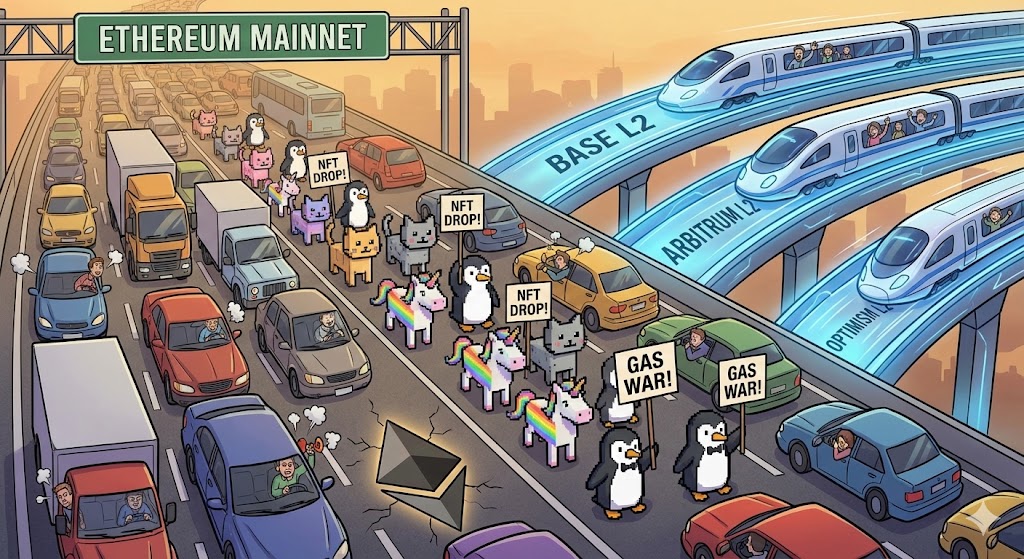
Getting stuck in traffic sucks. Everyone’s burning gas, but they’re going nowhere fast. And everybody’s grumpy about it. That’s Ethereum when things get a bit busy. It’s the smart contract king, the undisputed main highway for everything DeFi and the hottest NFT stuff. But sometimes the king’s caravan makes its own traffic jam and then gets stuck in it.
Now imagine a super-fast toll road right next to the main highway. Goes the same places. Does the same things. And it zips you past the gridlock for a fraction of the price. That’s what Layer 2s (L2s) are. They’re the happy-to-help sidekicks, the shortcut express lanes that make Ethereum’s job easier. And not like your Uncle Findlay’s “shortcuts” that always end with swearing while trying to read a 20-year-old map in the dark.
Yo, fam! I’m Geck0x, and my mission is to slice through the crypto cacophony like a blockchain samurai. By the end of this post, you’ll know exactly what L2s are, why they’re the most important thing happening in crypto right now, and which ones you should be watching. No PhD in computer science required. Let’s hit it, superheroes.
The Problem: Why Ethereum Gets Congested
So, why does the king’s highway get so jammed in the first place? As much as I’d like to blame goofy NFT cats, it really all comes down to Ethereum’s design. Think of it as a single-lane, one-way road. Every single car (every Ethereum transaction) has to stop at the same toll plaza to be checked and approved by the entire network, and every tollbooth (node) has to agree. That takes time. Especially when half the chain is minting mangy cat NFTs and buying cross-eyed gorilla memecoins. The latter sounds kinda cool, just saying.
- Ethereum is what we call a “Layer 1” blockchain. Its job is to be the ultimate source of truth. Once something happens onchain, it stays happened. Well, except that one DAO thing… but let’s move on. Ancient history, right?
In crypto, there’s an idea called the Blockchain Trilemma. In lay-lizard terms, it’s the goal of achieving three things at once:
- Decentralization: Ethereum is good at this; thousands of computers verify transactions and no single node or group runs the show.
- Security: Ethereum is good at this too. Billions of dollars worth of staked ETH help ensure that nobody can change past transactions.
- Scalability: Keeping it real, Ethereum as a standalone chain still sucks at this. Things get slow and expensive at times.
Most chains, including Ethereum, have two of the three figured out, but turning up the volume knob on the third would diminish the other two. Scalability (maintaining high performance under higher traffic loads) is the toughest one to solve without stepping on decentralization or security.
When everyone wants to use that single-lane road at once, the price of a “toll” (the gas fee) skyrockets. You’re literally bidding against other users just to get your transaction processed.
Scalability remains a weak point on Ethereum, but that’s where Layer 2 chains come into the picture. Vitalik Buterin, one of the co-founders of Ethereum discussed the limits to blockchain scalability at length. Much respect, but that dude can go on and on for days and the key takeaway is that Ethereum is building better features to support L1-L2 on and off ramps and solve those blockchain traffic jams.
The Solution: Enter the Layer 2 Sidekicks
Alright, so we’ve got a cryptotastic traffic jam on the main highway. A bunch of NFT cats and some new unicorn dApp are clogging up the works. The solution isn’t to bulldoze the whole thing, cats, unicorns and all, and then just start over. Cats and unicorns are people too. The real solution is to build smarter, faster roads right next to it. That’s exactly what Layer 2s are.
L2s don’t replace Ethereum. Instead, they work alongside Ethereum. Think of Layer 2 networks like Base and Arbitrum as express lanes that connect to the main highway. They handle some of the everyday traffic so the main road (Layer 1) can focus on the big picture: staying decentralized and making sure the bad guys can’t change transactions on the chain.
Here’s how the hand-off works, broken down into three simple steps:
- Batching Transactions: You and a zillion other people want to make transactions. Minting NFT cats, maybe. Instead of sending them one by one to the congested Ethereum mainnet, the L2 scoops them all up and bundles them into a single, compressed package.
- Sending the Summary: The L2 doesn’t send every single NFT cat transaction to Ethereum. Instead, it sends just one summary receipt to the main chain, essentially saying, “Hey, here’s the proof that all these transactions are legit.” All transactions are bundled this way, whether it’s cat NFTs or sending ETH to your friend who’s always broke.
- Ethereum’s Final Word: Ethereum (Layer 1) receives this one big summary transaction and uses its ultimate security to stamp it as official and final. Some L2s have a challenge period (optimistic rollups), while others use fancy math to prove the transactions are legit before sending them over (ZK rollups).
The payoff is huge. You get the same rock-solid security as Ethereum, but with transactions that are nearly instant and (usually) cost a fraction of a cent.
Meet the Sidekicks: A Quick Guide to Popular L2s
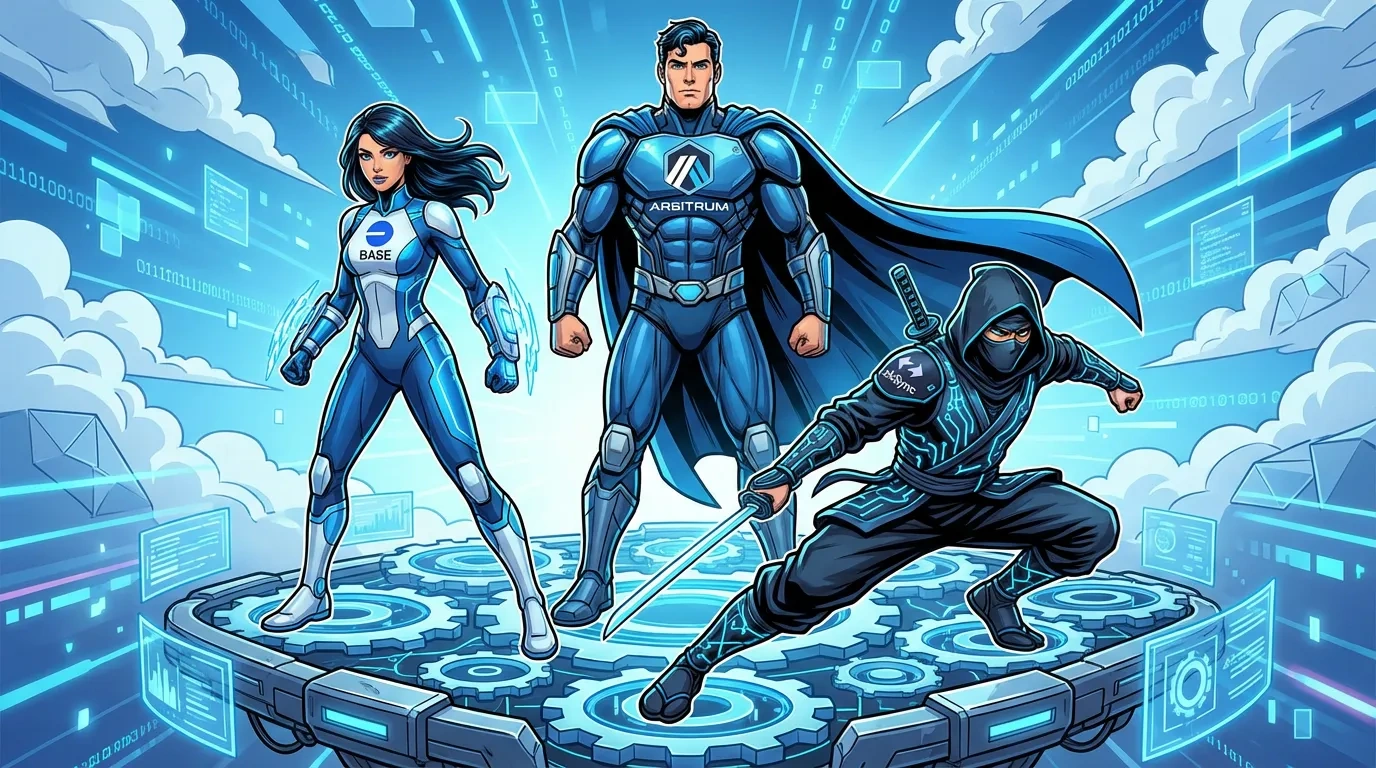
Not all L2 sidekicks work the same way, but they all use Ethereum for security and they all run the Ethereum Virtual Machine (EVM). Each Layer 2 brings its own vibe and special powers. Let’s meet the main players on the block.
Arbitrum & Optimism (The Optimistic Rollups)
-
The Vibe: The OG sidekicks. They’re the reliable, fast, and widely adopted express lanes that most of the big dApps call home.
-
How They Roll: They’re “optimistic.” They assume all transactions in a batch are valid and post them to Ethereum quickly.
It’s a system of trust with a safety net: if someone spots a fraudulent transaction, they can challenge it within a time window. Think of it as an “innocent until proven guilty” system.
Base (The Coinbase Connection)
-
The Vibe: The new, cool kid on the block. Built for speed, ease of use, and a smooth on-ramp via Coinbase for the next zillion crypto users.
-
How They Roll: Also an Optimistic Rollup, but with the backing of Coinbase. This makes it super easy for people to bridge their assets over and start exploring the cryptoverse. Base is designed to make crypto simple for normies.
zkSync & StarkNet (The Zero-Knowledge Proofs)
-
The Vibe: The high-tech, mysterious ninjas of the L2 world. They’re all about cutting-edge cryptography and next-level privacy.
-
How They Roll: ZK rollups use fancy math called zero-knowledge proofs to create a cryptographic “proof” that all transactions in a batch are valid without revealing any of the details. It’s more private and, in theory, even more scalable.
Don’t sweat the nerdy tech for now. Just know these are the main crews building the blockchain highways of the future, and they’re all working to make your crypto life faster and cheaper.
Final Take on Layer 2 Networks
Layer 2s are the express lanes solving Ethereum’s traffic jam, and they’re the key to making crypto feel as slick and instant as we’d expect high-tech assets to be.
The most important thing to remember is that L2s aren’t competitors to Ethereum. Instead, they’re its greatest allies. And Ethereum, as awesome as it is, really needs them as much as they need Ethereum. L2s handle the traffic better. Ethereum protects the transaction ledger
The next time you’re about to make a transaction, check whether the dApp or protocol is available on your fav L2. Your wallet will thank you for it.
Stay cool, stay decentralized, and may your gas fees always be low. Geck0x, out.